How Diatrace lets your customers see where their diamond came from, and why the jewellers they trust most will be the first to ask for it.
At the counter
A customer holds the ring and asks, “Where did this come from?” Most counters can answer with a grade. Very few can answer with a history.
The four Cs describe the stone. Nothing on the tag describes its journey: who mined or grew it, who cut it, and whether they met the standards your brand promises.
A diamond changes hands many times before it reaches your showcase.
Every handoff has its own paperwork, and none of it travels with the stone.
01
Mine or lab
Extracted or grown
02
Rough trade
Sold across borders
03
Planning
Scanned and mapped
04
Cutting
Sawn and polished
05
Grading
Lab report issued
06
Jewellery
Matched and set
07
Your counter
The customer asks
Kimberley Process certificate. Covers shipments of rough, country to country.
From the first cut on, the stone is on its own. Its origin rests on invoices, warranties and trust between businesses.
Proof of origin is becoming a condition of sale.
Three pressures now meet at the retail counter, and they are all getting stronger.
gpp_good01
Regulation
G7 markets now require evidence that diamonds are not of Russian origin, and due-diligence law is making retailers answerable for their supply chains.
group02
Customers
Buyers research before they buy. Origin, ethics, and whether a stone is natural or lab-grown are now part of the sale.
workspace_premium03
Reputation
One sourcing story can undo years of brand building. “We trust our suppliers” is no longer a complete answer.
Introducing Diatrace
Diatrace gives every diamond a verifiable passport. Written by those who handled it, sealed on a blockchain, read with one scan.
Covers
Natural and lab-grown
From
Rough to finished jewellery
Adds
An audited ESG rating
Viewed
With one scan, no app
Your suppliers record it. The blockchain seals it. Your customer sees it.
The tracing is done upstream, by the facilities that handle each stone. You receive a stone that already carries its record.
route01
Recorded at every step
Each facility logs the stone as it moves: weight, process and location, with its documents such as the KP certificate, invoice and lab report.
deployed_code02
Sealed on a blockchain
Every step is anchored to a blockchain entry, so a history cannot be quietly rewritten after the fact.
qr_code_scanner03
Revealed with a scan
A QR code on the certificate, tag or box opens the stone’s full journey. No app to install and no account needed.
The whole journey, in your customer’s hand.
A scan opens a public page showing the stone’s route from source to showcase, the documents behind each step, and its ESG rating.
checkOpens on any phone, with nothing to install
checkStates whether the stone is natural or lab-grown
checkShows where and when each step happened
checkPhotos, videos and 3D scans at every stage
checkCommercial documents stay private to the trade
Verified
Natural diamond
1.02 ct Round Brilliant
D · VS1 · Excellent cut
9.5/ 10ESG score
Rough receivedAntwerp · KP certificate attached
Planned and sawnSurat · 1 of 3 stones from the rough
PolishedSurat · 2.41 ct → 1.02 ct
GradedMumbai · Lab report linked
Set in 18k white goldMumbai · Solitaire ring
Arrived at your store
encryptedRecorded on the Diatrace blockchain
Illustrative record
Provenance, plus a measure of impact.
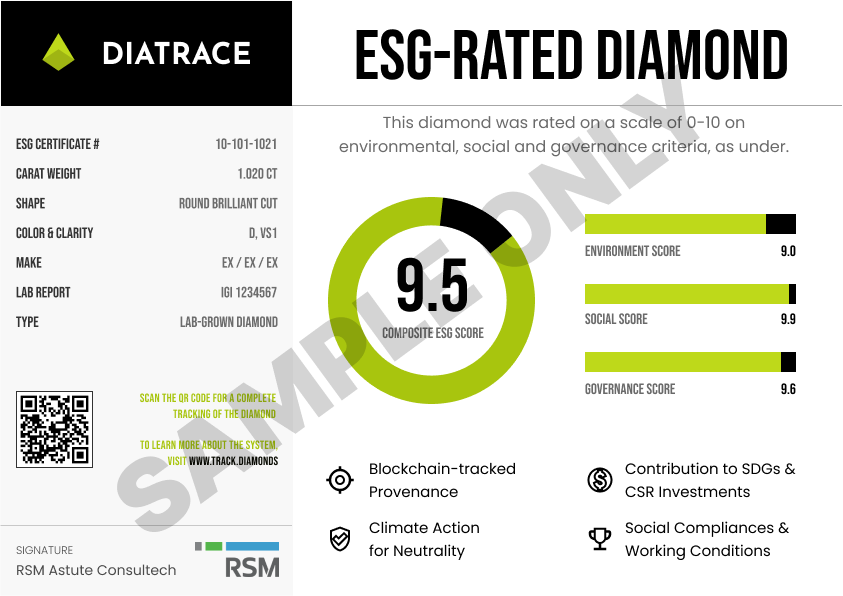
Stones from audited facilities can carry a Diatrace ESG certificate: a single score for the environmental, social and governance footprint behind the diamond.
01Scored from 0 to 10 on E, S and G
02Facilities audited by RSM, not self-declared
03Linked to the traced record by QR code
Sample ESG certificate
What traceable diamonds do for a retailer.
You aren’t buying software. You’re offering customers a better answer, and protecting your name while you do it.
01
A story that sells
Turn the provenance question from a reason to hesitate into a reason to buy.
02
Evidence on demand
Answer auditors, regulators and the press with records, not assurances.
03
Clarity on natural and lab-grown
Each record states the stone’s nature from its source onwards.
04
A stronger supplier base
See which suppliers can prove their chain, and which cannot.
Traceability is recorded upstream. It is switched on downstream.
Miners and manufacturers trace when their customers ask for it. Retailers are that customer, so your request is what sets the chain in motion.
Three things only a retailer can do.
Each is small on its own. Together they give your suppliers a clear reason to trace, and your customers a reason to notice.
01
Ask for it
Name Diatrace traceability in your sourcing requirements, starting with one category or collection.
02
Introduce your suppliers
Share your key manufacturers. We onboard them directly, with zero setup cost.
03
Show it
Put the QR code on tags, certificates and product pages, and brief your sales team on the story.
Verifying a traced stone costs you nothing.
The facility that traces the stone pays for tracing. Anyone can open a record, free, from any device.
$0
for you or your customers to view and verify any traced stone
$1/ stone
paid by the supplier that traces it, plus a platform fee from $99 a month
$0setup
for the suppliers you introduce, with onboarding support from our team
Start with one collection, live in 90 days.
A pilot keeps the scope small and the story real, with results you can measure before scaling.
Weeks 1–2
Choose
Pick a collection and the two or three suppliers behind it. Agree what the customer will see.
Weeks 3–8
Trace
Suppliers are onboarded and record new production on Diatrace, step by step.
Weeks 9–12
Launch
QR codes go live in store and online. We measure scans, questions and conversion together.
Proposed pilot plan. Timings depend on supplier readiness.
Let the stone speak for itself.
Tell us which collection you’d like to trace first. We’ll bring your suppliers on board.

 Verified